Decoration method

Dye Sublimation

Dye sublimation transfers a printed design into suitable polyester fabric or a sublimation-ready coating. It is suited to full-color artwork on compatible light-colored products.

The artwork is printed onto transfer paper, the substrate is confirmed as polyester or as a coated blank, the transfer is positioned and pressed with the heat and pressure the material and equipment require, and the carrier is removed and the print checked against the surface.

Get a Quote Products printed this way

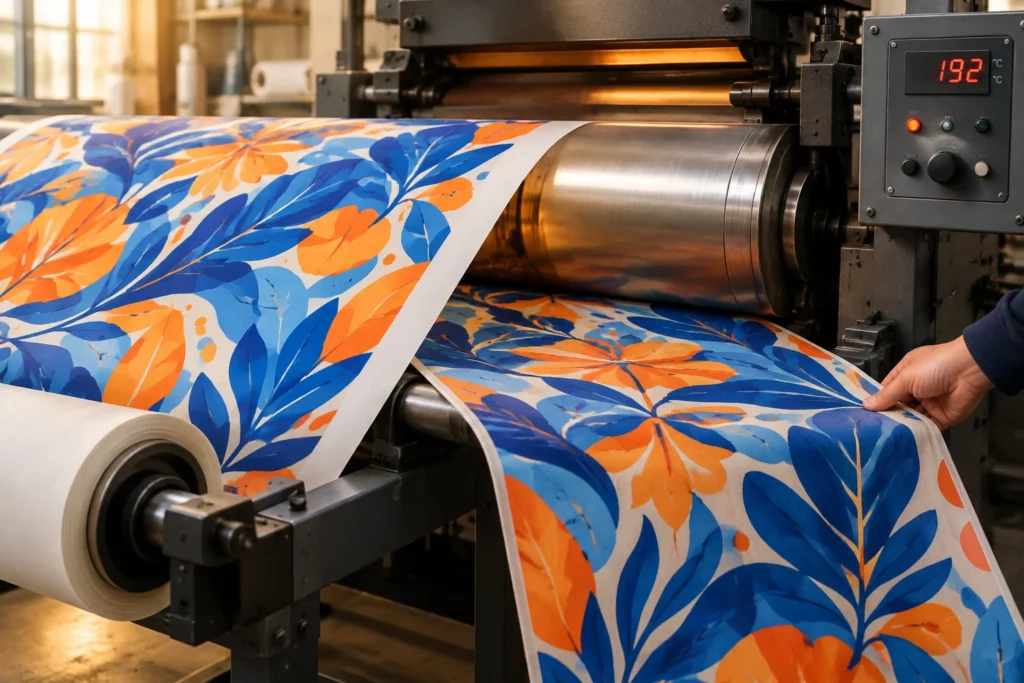
Sublimation calendar press with a blue and orange leaf transfer paper feeding into the heated drum, the same pattern emerging dyed into polyester fabric on the other side, panel reading 192 degrees

Quick facts

Colors
Color is possible; the number is confirmed with the artwork
Surfaces it takes
Flat · Shallow curve · Cylinder
Materials
Fabric · Ceramic · Plastic
Minimum order
300 pieces
What drives the cost
Printed area · Piece count · Setup and screens

One color and several colors

Sublimation on fabric
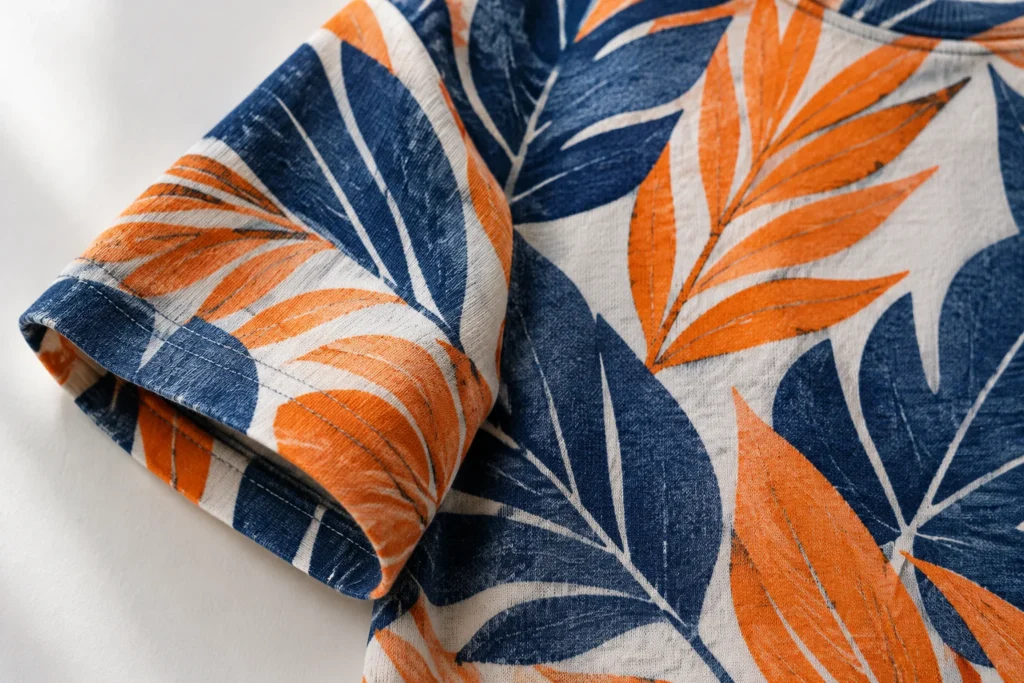
Light polyester t-shirt with a navy and orange leaf pattern dyed into the knit, the print following every fibre with no film or gloss, the sleeve cuff folded to show the wrap

On light polyester fabric: the design is dyed into the fabric itself, in the colors of the artwork.
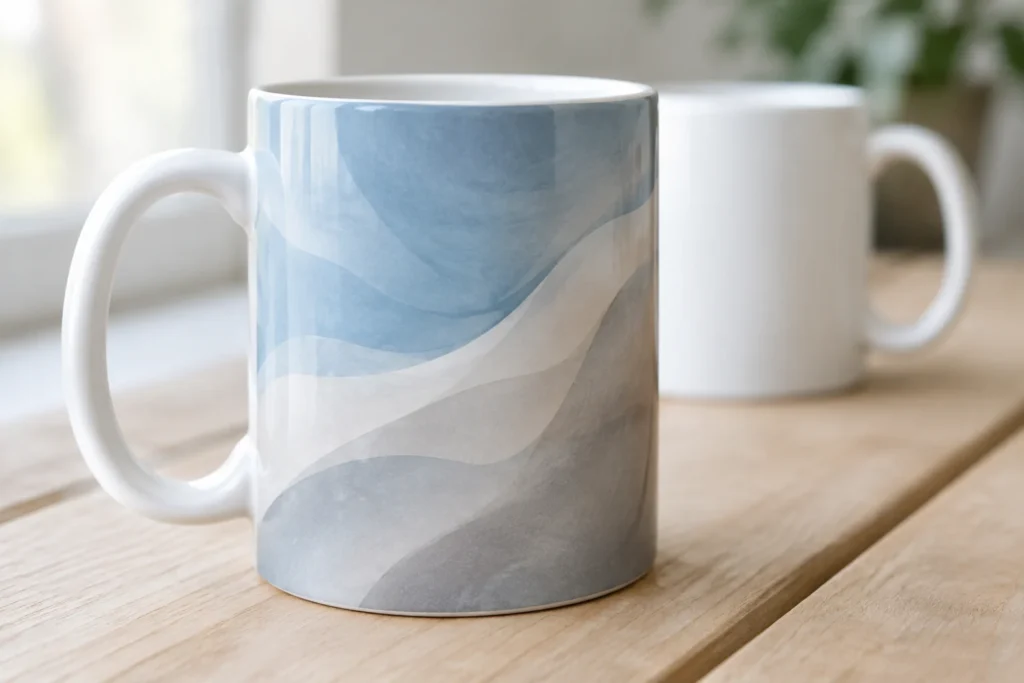
Sublimation on a coated mug

White coated ceramic mug with a soft blue and grey gradient printed around its curve, glossy glaze, plain handle in the foreground and a blank mug behind

On a coated mug: full-color artwork on a body that carries a sublimation-ready coating.
How Dye Sublimation works

  • Prepare the transfer The artwork is prepared for the substrate and printed onto transfer paper.
  • Confirm the substrate We check that the fabric is polyester or that the hard item carries a sublimation-ready coating.
  • Press the design The transfer is located and pressed with the heat and pressure the material and equipment require.
  • Check the surface The carrier is removed and the print is checked against the surface for position and even color.
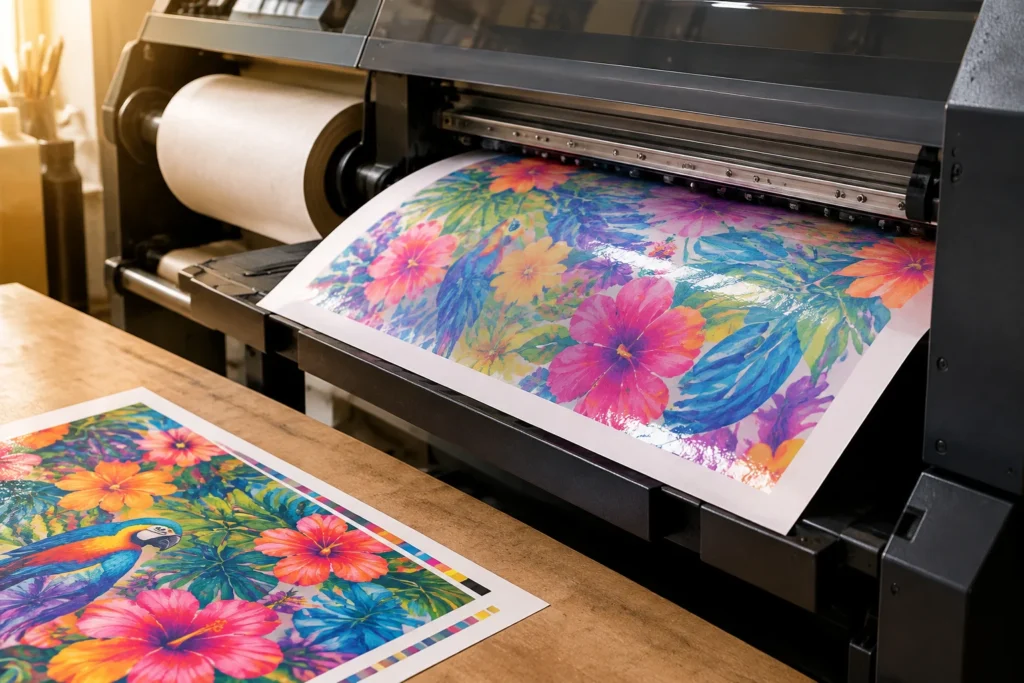
Wide-format printer feeding a sublimation transfer sheet with a saturated floral and parrot pattern still glossy with ink, the transfer roll behind and a printed sheet with colour bars on the bench
Prepare the transfer The image is printed in reverse onto sublimation transfer paper, saturated because it has to carry the colour into the fibre.
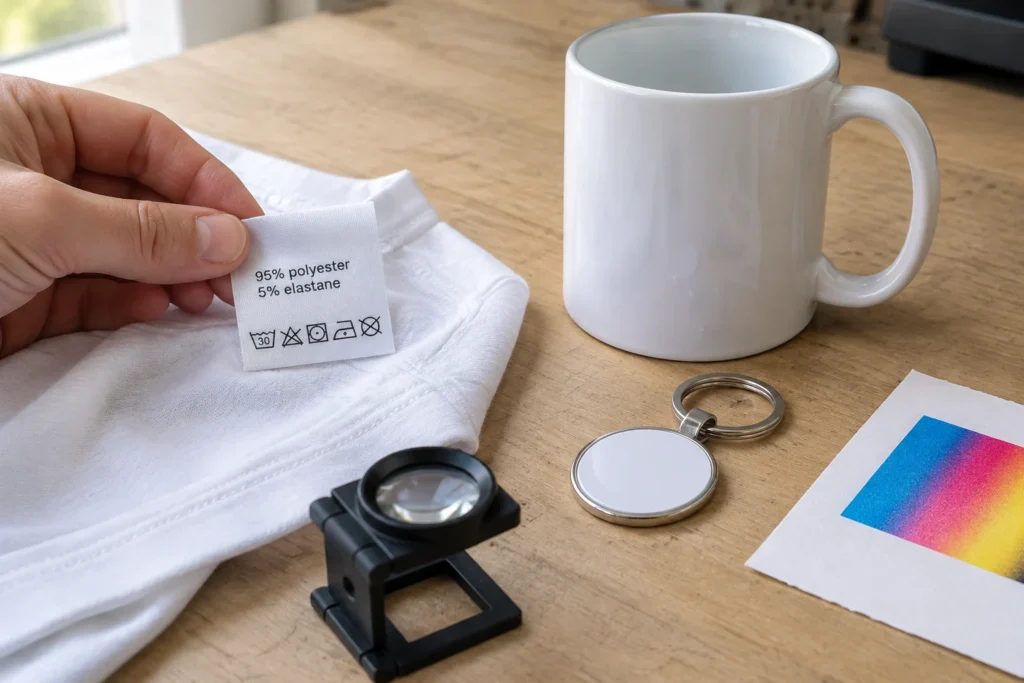
Hand holding out a care label reading 95 percent polyester and 5 percent elastane, beside a coated white mug, a coated keyring blank, a folding magnifier and a colour patch transfer sample
Confirm the substrate The piece has to take the dye, so the fibre or the coating is confirmed before anything is printed.
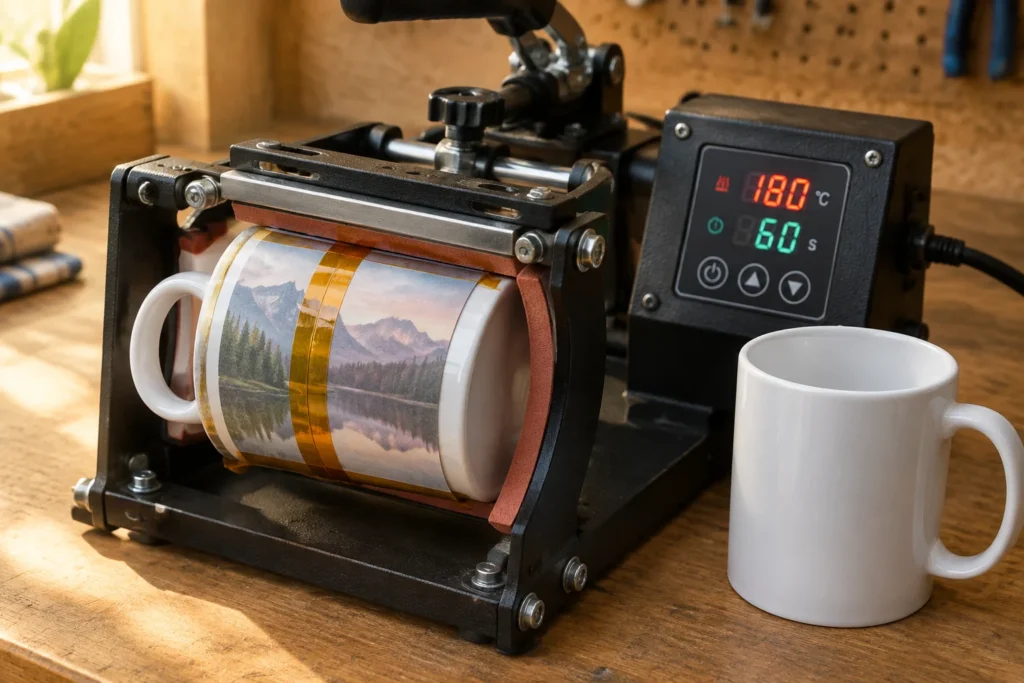
Mug press clamped around a white mug wrapped in a mountain landscape transfer sheet secured with heat tape, controller showing 180 degrees and 60 seconds, a blank mug beside it
Press the design Heat and pressure turn the solid dye into gas so it moves into the fibre, then the piece cools with the image set.
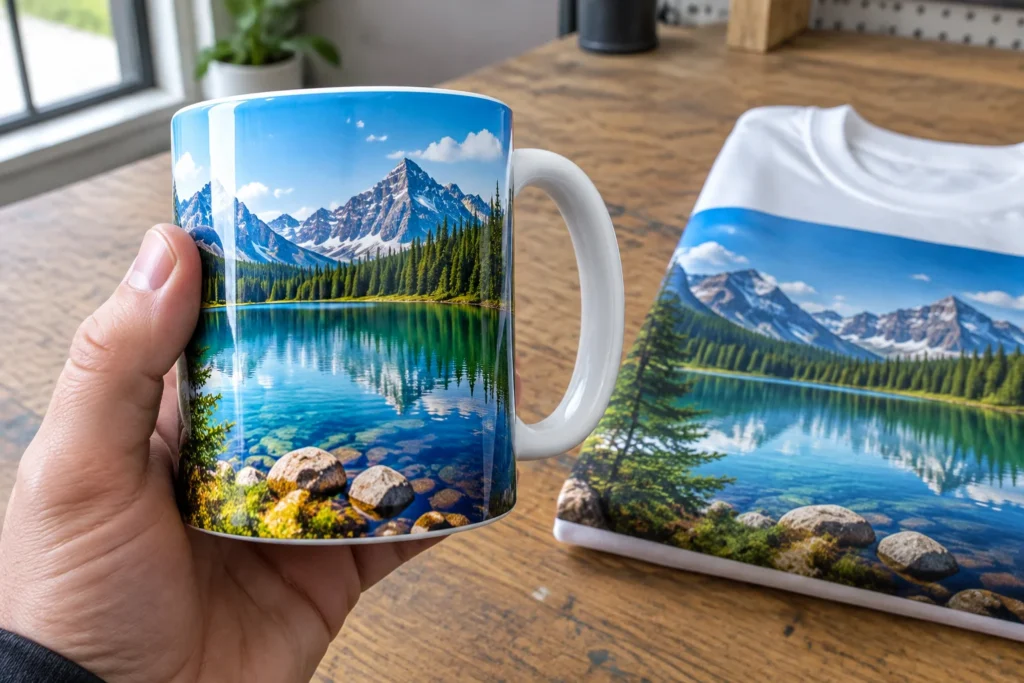
Hand holding a finished sublimated mug with the landscape print running to its rim over a continuous glaze, a finished matching t-shirt folded on the bench behind
Check the surface The piece is checked for tone, edge sharpness and coverage, because a sublimated print cannot be corrected afterwards.

Surface suitability It is best suited to light-colored polyester and purpose-coated blanks, where the surface itself carries the color and no raised print layer is left behind.

Best for

  • Full-color artwork photographic and gradient designs go onto compatible surfaces without a white ink underlayer.
  • No raised film on polyester the design is dyed into the material, so the surface stays smooth to the touch.
  • Wrap-around placement coated cylindrical items such as mugs can take a design across the body, evaluated per shape and fixturing.
  • Light bases preferred pale polyester and white coated blanks give the cleanest result, which suits apparel and accessories.

Where it falls short

  • Polyester or coating required ordinary cotton and uncoated hard goods are not suitable and need a different method.
  • No white ink white in a design comes from the substrate, so white lettering on a dark base is not available this way.
  • Light backgrounds preferred a dark substrate shifts the printed color, so the artwork is reviewed against the actual piece.
  • Shape follow-through the result depends on heat-press contact and fixturing, so deep or complex shapes are evaluated before quoting.

We do not publish a polyester-content threshold, a wash-cycle count or a color match to a screen rendering. The substrate, the coating and the artwork are checked together, and wash expectations are confirmed during quotation and sampling. We do not promise that ordinary cotton, uncoated ceramic or dark blanks will take the print.

Common printing issues & what to check

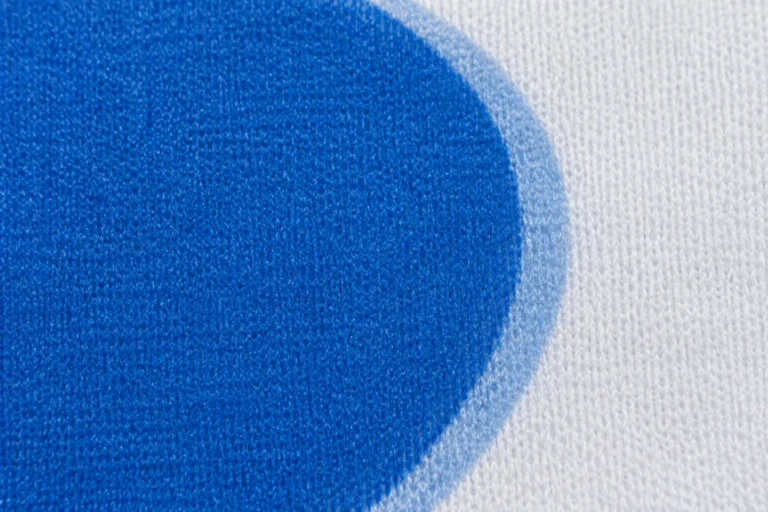
Macro of a solid blue sublimation print with a faint offset second edge a few millimetres outside it, the ghost of the shape on white knit
Illustrative

Ghosting and double edges

Possible issue A faint second image appears where the transfer shifted during pressing, or where the carrier was removed unevenly.

What to check Check how the transfer paper is held in place, and how the carrier is removed from the piece.

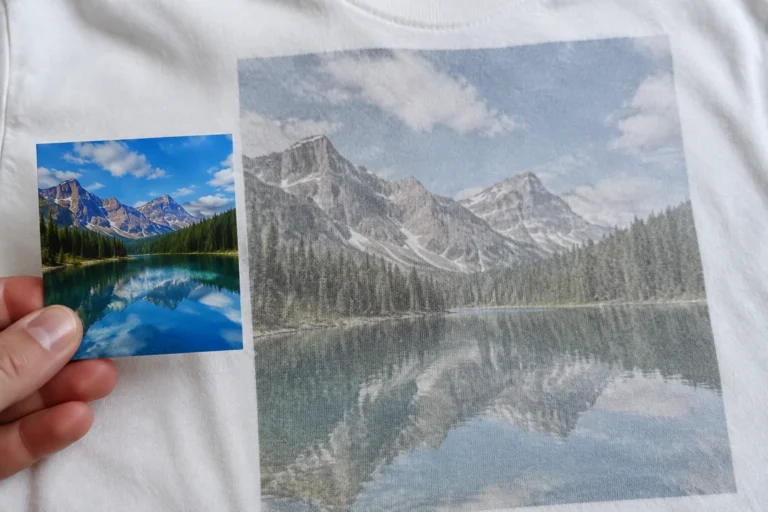
Vivid mountain and lake photo held beside the same image sublimated on a white t-shirt where it has come out dull and grey by comparison
Illustrative

Dull or off-tone color

Possible issue The print reads pale or off-tone against the approved layout.

What to check Check the base color of the piece, whether the coating is the right one for sublimation, and the material match.

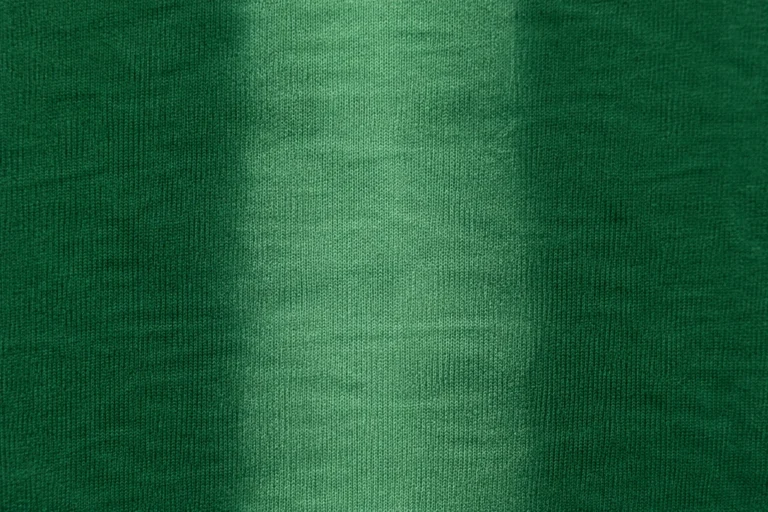
Solid deep green sublimated panel on white knit with a broad lighter vertical band through the middle where press contact was inconsistent
Illustrative

Uneven coverage

Possible issue Part of the design is lighter where press contact or fixturing was inconsistent.

What to check Check the contact across the whole print area, and the consistency between pieces in the run.

Artwork & production confirmation

  • Logo or artwork file — vector AI, EPS or PDF with text converted to outlines, or a clear image file at the intended size.
  • Substrate — the fabric or the coated hard item, with its color and, for fabric, what it is made of.
  • Coating — for hard goods, confirmation that the actual item carries a sublimation-ready coating.
  • Size and position — the print width and height, and where it sits, including any wrap-around requirement.
  • Quantity and color reference — the piece count and the reference colors you expect, on the understanding that the print is confirmed on the substrate.

What we confirm

Before production we confirm the fabric or the coating, the base color of the piece, the artwork size and position, any wrap-around requirement, the quantity and the intended use. A coat or a fabric grade is checked on the actual item, and where the customer's approval is required, photos or video of the actual sample are shared before bulk production. Wash and care expectations are agreed at the same stage.

What a digital proof shows

A digital proof shows layout, size and placement only; it does not show real texture, print density, adhesion or wash behaviour, so it is not a physical sample.

Pricing and order policies

Dye Sublimation Costs

Setup fees and per-item printing charges are listed separately in your quote.

Print option Setup fee Per-item printing
Dye sublimation, one position $50. One-time preparation for the run. The per-item cost is quoted with the product and the run quantity; no flat decoration price is published.
Each additional position — +$0.05–$0.08 per item for a second position; any further position is confirmed in the quote.

*Check the product quote for included decoration. Additional-position pricing depends on the product and print area.

Samples

  • Sample-making fee for dye sublimation: $50–$100.
  • New customers generally pay a sample-making fee in addition to any applicable setup or tooling fee. Existing customers generally do not pay a sample-making fee. We cover the sample product and its shipping. The sample-making fee is refunded at final balance settlement when the bulk order is essentially unchanged from the approved sample in product, material, artwork and finish. Setup and tooling fees are non-refundable.

Repeat orders

  • Repeat-order reuse is subject to this method's own conditions below. Changes to the artwork, size or other tooling-dependent features may require new preparation. A position change alone does not automatically require new tooling.
  • The same artwork, substrate and process parameters can reuse the previous preparation. A change of fabric, or a coated product whose coating changes, needs a new sample.

Dye Sublimation or DTG Printing

What to compare Dye Sublimation DTG Printing
Artwork it suits Full-color artwork with photographs and gradients, prepared for the light background of the piece. Full-color artwork prepared for a garment fabric, with the white base handled inside the print.
Product surface Light-colored polyester fabric, or a rigid item that carries a sublimation-ready coating. Suitable apparel fabrics, where the ink is applied to the textile rather than dyed into it.
What drives the quote Coverage, the substrate or its coating, the number of positions and the quantity. Print area, the garment or product itself, ink use and the quantity.
Confirm before ordering Confirm that the actual item is polyester or carries a sublimation coating, then approve a sample pressed on it. Confirm that the actual fabric suits DTG, then approve a sample printed on that garment.

The two columns describe what each process can hold on a surface, not a comparison of finished quality. Send the artwork and the item, and the recommendation comes with the reason for it.

How the order runs

  1. Artwork and product check We review the artwork, the product and its surface together, agree the substrate, size and placement, and quote from that.
  2. Pre-production sample and approval The factory prepares a pre-production sample. Where customer approval is required, we share photos or video of the actual sample before bulk production, and a physical sample can be shipped on request.
  3. Production Once the substrate and the layout are approved, the order runs as reviewed on this page.
  4. Inspection and delivery Routine visual checks plus simple manual adhesion and fingernail scratch checks where applicable, on samples from the production batch. Inspection records can be provided and professional testing can be arranged at extra cost. Unchanged repeat orders are inspected against the retained sample from the previous bulk run.

Products that use this method

No product in the catalogue is filed under this method yet. We can still print it on an item we source for you.

Whichever method you print with, these services carry it through: Logo Printing & Product Customization, Sampling & Approval, Production Monitoring & Quality Checks.

Questions about this method

Can an ordinary ceramic mug be sublimated?

Only when the item carries a coating made for sublimation. A standard glazed mug is not a sublimation surface, so the actual item is confirmed before the artwork is prepared.

Can you print white?

No white dye is used. White in a design comes from the material itself, so white lettering and pale artwork work on a light base and not on a dark one.

Can a design wrap around the product?

Wrap-around placement is evaluated per product: the shape, the fixturing and the artwork are checked together, and the quote states what can be printed.

What is the minimum order?

The method MOQ is 300 pieces. The quantity for a specific product is confirmed in the quote.

What does a sample cost?

New customers generally pay a sample-making fee in addition to any applicable setup or tooling fee; existing customers generally do not. We cover the sample product and its shipping, and the sample-making fee is refunded at final balance settlement when the bulk order is essentially unchanged from the approved sample. Setup and tooling fees are non-refundable.

Do you guarantee a wash result?

No wash-cycle count is published. Washing expectations are confirmed during quotation and sampling, and professional testing is arranged at additional cost if you need it verified.

Longer reads about this method: How to Choose Promotional Drinkware.

Send the artwork

A logo and the item is enough to start. If this method will not hold your artwork on that surface, we say so before you order rather than after the deposit.

Request a quote All methods